

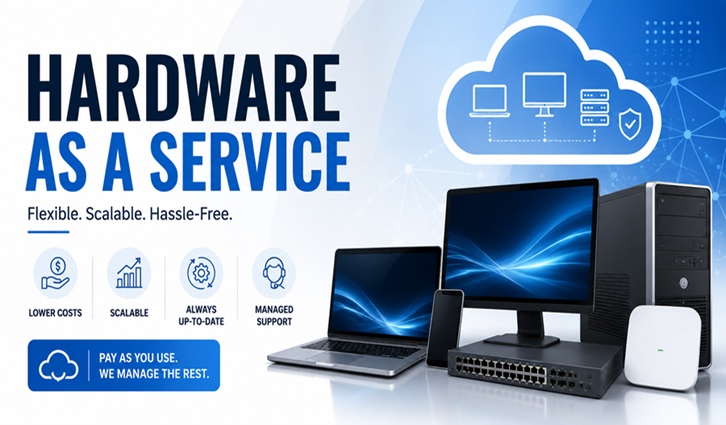
Buying hardware used to be straightforward. Your company needed servers, laptops, or networking equipment — you purchased it, depreciated it over time, and replaced it when it wore out. That model worked for decades. But rising technology costs, faster refresh cycles, and tighter IT budgets have pushed many businesses toward a different arrangement: Hardware as a Service, or HaaS.
It’s not a radical concept, but the shift it represents is significant. Instead of owning physical equipment outright, companies pay a recurring subscription fee to access and use hardware managed by a third-party provider. The provider handles procurement, maintenance, upgrades, and end-of-life disposal. The business gets the equipment it needs without the capital expenditure, the logistics headache, or the risk of being stuck with outdated gear.
How HaaS Actually Works
At its core, HaaS is a subscription model for physical technology. A provider supplies hardware — servers, workstations, networking infrastructure, point-of-sale systems, IoT devices — under a contract that typically runs one to five years. That contract covers more than just the equipment itself.
Most HaaS agreements bundle in:
- Installation and configuration at the start of the contract
- Ongoing maintenance and repairs throughout the term
- Hardware refresh cycles so equipment is replaced before it becomes a liability
- End-of-life asset management, including secure data wiping and disposal
Payment is structured as a monthly or annual operating expense rather than a large upfront capital purchase. For accounting and budgeting purposes, that distinction matters more than it might initially appear.
The Financial Case for HaaS
The most immediate appeal is cash flow. Outright hardware purchases — especially at enterprise scale — require significant capital that then sits on the balance sheet as a depreciating asset. HaaS converts that capital expenditure (CapEx) into an operating expenditure (OpEx), which is often more flexible, easier to budget, and in many jurisdictions, more tax-efficient.
But the financial argument goes deeper than accounting treatment. Hardware ownership carries hidden costs that rarely show up in the initial purchase price: staff time spent on maintenance, unplanned repair costs, the productivity loss when equipment fails, and the expense of responsible disposal when hardware reaches end of life. HaaS providers absorb most of these costs into the subscription, making total cost of ownership more predictable.
For small and mid-sized businesses without large IT departments, this predictability is particularly valuable. A single server failure can cost thousands in emergency repairs and downtime. Under HaaS, that risk sits with the provider.
Where HaaS Makes the Most Sense
HaaS isn’t the right answer for every organization or every type of equipment. It works best in specific scenarios:
High refresh-rate environments. Technology that becomes obsolete quickly — laptops, tablets, networking hardware — is an ideal candidate for HaaS. Instead of being locked into devices for five or six years, businesses can upgrade on a defined schedule as part of their contract.
Distributed or multi-location operations. Retailers, healthcare networks, and logistics companies with equipment spread across dozens of sites benefit from having a single vendor handle deployment, maintenance, and replacement rather than managing it location by location.
Businesses scaling rapidly. A startup or growing company that needs to add 50 workstations this quarter and potentially another 100 next quarter gains flexibility from HaaS that an outright purchase model doesn’t easily provide.
Organizations with lean IT teams. When internal IT staff are already stretched, offloading hardware lifecycle management to a provider frees up time for higher-priority work.
The Trade-offs Worth Considering
HaaS has real advantages, but it comes with trade-offs that deserve honest consideration before signing a contract.
Over a long enough timeline, subscription costs can exceed what outright purchase would have cost — particularly for hardware with long useful lives. Organizations with stable, predictable hardware needs and the capital to buy outright may find ownership more economical in the long run.
Vendor dependency is another factor. When your hardware is tied to a provider’s contract, switching costs can be significant. Contract terms, especially around early termination, warrant close scrutiny before committing.
Data security during hardware transitions also requires attention. Businesses handling sensitive data need clear contractual guarantees about how devices are wiped and disposed of when they’re cycled out or returned.
HaaS Within the Broader “as a Service” Landscape
HaaS sits alongside Software as a Service (SaaS) and Infrastructure as a Service (IaaS) as part of a broader shift toward subscription-based technology consumption. The common thread is moving from ownership to access — paying for outcomes and capacity rather than physical or perpetual assets.
For IT decision-makers evaluating this model, Gartner’s research on IT financial management provides useful frameworks for comparing CapEx versus OpEx approaches across technology investments.
The underlying question HaaS answers is straightforward: does your business benefit more from owning technology or from having access to it? For a growing number of organizations, the answer is shifting toward access — and the hardware industry is adjusting accordingly.


 lets businesses access and use hardware through a subscription instead of buying it outright. Here's how it works and who benefits most.)