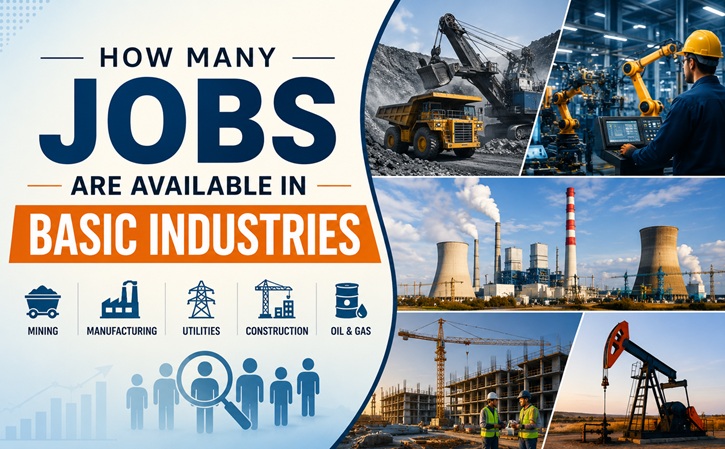
When economists talk about the backbone of an economy, they’re usually talking about basic industries. These are the sectors that produce raw materials, manufacture goods, and supply the foundational inputs that every other part of the economy depends on. And despite the attention that tech, finance, and services tend to attract, basic industries remain one of the largest sources of employment in the United States and globally.
The exact number shifts with market conditions, but the scale is consistently significant — and often underestimated by people who don’t work in these sectors.
What Counts as a Basic Industry?
Before getting into numbers, it helps to define the category. Basic industries are sectors that extract, process, or produce fundamental goods — the kind that feed, fuel, and build everything else. They include:
- Agriculture and farming
- Mining and extraction (coal, oil, natural gas, metals)
- Steel and metals manufacturing
- Forestry and paper production
- Chemical manufacturing
- Energy production (utilities, power generation)
- Construction materials
These aren’t glamorous headlines, but they represent millions of stable, often well-paying jobs that exist regardless of whether the stock market is up or the latest app has launched.
The Employment Numbers
In the United States alone, basic industries account for tens of millions of jobs when the full supply chain is considered.
Agriculture employs roughly 2.6 million wage and salary workers directly, according to Bureau of Labor Statistics data — but when you factor in related food processing, equipment, and distribution roles, that figure climbs considerably higher.
Mining and extraction supports around 700,000 direct jobs in the U.S., with oil and gas extraction making up the largest share. These positions tend to offer above-average wages, particularly for skilled trades and engineering roles.
Manufacturing — which overlaps heavily with basic industries — employed approximately 13 million Americans as of recent BLS data. Within that, metals, chemicals, and industrial machinery production represent a substantial portion.
Construction, closely tied to basic material industries, accounts for another 8 million jobs and counting, with demand currently outpacing supply in many skilled trades.
Energy and utilities add roughly 500,000 to 600,000 direct jobs, a number that is actively growing as renewable energy infrastructure expands across the country.
Taken together, a conservative estimate puts basic industry employment in the United States somewhere between 20 and 30 million jobs — depending on how broadly you define the category and how far down the supply chain you count.
Why These Jobs Are Still in Demand
There’s a persistent assumption that automation and offshoring have hollowed out basic industries. The reality is more nuanced. While certain roles have been automated or moved overseas, demand for skilled workers in these sectors has remained steady — and in some cases, grown.
Several factors are driving continued hiring:
Aging workforce. A significant portion of the skilled labor force in mining, manufacturing, and construction is approaching retirement age. Replacing that institutional knowledge requires sustained recruitment and training.
Infrastructure investment. Government infrastructure spending — on roads, bridges, energy grids, and broadband — has injected fresh demand into construction and materials sectors in recent years.
Reshoring trends. Supply chain disruptions in 2020 and 2021 pushed many companies to bring manufacturing back closer to home. That shift has created new domestic jobs in sectors that had been declining for years.
Energy transition. The move toward solar, wind, and battery storage isn’t eliminating energy jobs — it’s changing what skills are needed. Electricians, engineers, and equipment operators are in high demand across both traditional and renewable energy projects.
The Wage Picture
One reason basic industries continue to attract workers despite physical demands and sometimes remote locations is pay. Many of these roles offer wages that outpace service-sector alternatives without requiring a four-year degree.
Median annual wages in oil and gas extraction, for example, regularly exceed $60,000. Experienced tradespeople in construction and industrial manufacturing frequently earn $70,000 to $90,000 or more. For workers willing to pursue apprenticeships or technical certifications rather than traditional college paths, basic industries represent one of the more accessible routes to a middle-class income.
Where to Find Openings
Job availability in basic industries fluctuates regionally. Energy jobs concentrate in Texas, North Dakota, and the Gulf Coast. Forestry and agriculture dominate rural regions of the Midwest, South, and Pacific Northwest. Manufacturing hubs remain active across the Great Lakes states and parts of the Southeast.
The U.S. Bureau of Labor Statistics Occupational Outlook Handbook is the most reliable resource for tracking current employment figures, projected growth rates, and wage data across every major basic industry sector — broken down by state and occupation.
The Bigger Picture
Basic industries don’t generate the cultural conversation that tech startups or financial markets do, but their employment footprint is massive and their role in the economy is non-negotiable. Raw materials have to come from somewhere. Energy has to be generated. Infrastructure has to be built and maintained.
For job seekers, career changers, or anyone trying to understand where stable, long-term employment actually exists — basic industries deserve far more attention than they typically get.