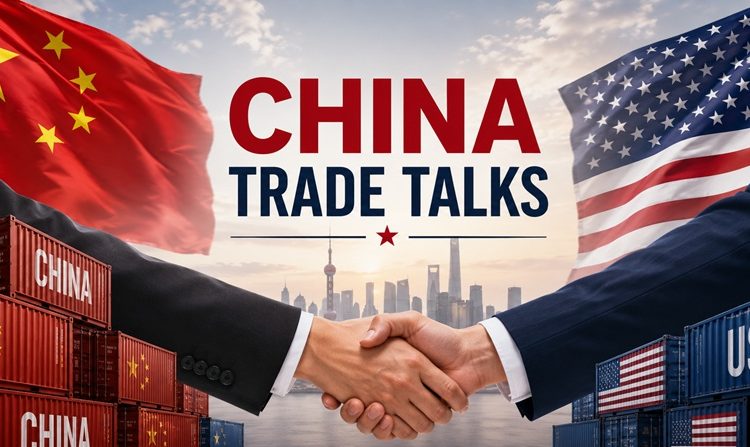
The relationship between the United States and China is the most consequential economic partnership on the planet — and for most of 2025, it was also the most turbulent. Reciprocal tariffs climbed into triple digits, rare earth export controls threatened global supply chains, and soybean purchases from American farmers ground nearly to a halt. The damage was measurable, the uncertainty was deliberate, and the path forward was anything but clear.
By mid-2026, the picture looks meaningfully different. A trade truce negotiated in late 2025 has held, a landmark summit in Beijing has produced a new set of commitments, and both sides are now navigating what cautious observers are calling a stabilization rather than a resolution. The distinction matters.
How the Trade War Escalated in 2025
The current chapter of US-China trade friction began aggressively when President Trump’s second administration took office. Tariffs on Chinese imports were raised sharply under Section 301 investigations, reaching levels that rattled global markets and prompted immediate retaliation from Beijing. China halted purchases of American-grown soybeans, imposed its own retaliatory tariffs, and — critically — tightened restrictions on exports of rare earth minerals and critical materials including gallium, germanium, antimony, and graphite. These are materials that American manufacturers need to produce semiconductors, smartphones, electric vehicles, and military equipment.
According to analysts at the Peterson Institute of International Economics, “Trump found out that he doesn’t have the leverage over China that he does over others” — a recognition that the interdependencies in the US-China relationship cut both ways, constraining the leverage available to both sides.
The tit-for-tat dynamic showed just how exposed both economies were. US soybean exports to China dropped 75 percent in 2025 — devastating for American agricultural producers who had rebuilt their market share following the first trade war earlier in the decade.
The October 2025 Breakthrough
The first meaningful de-escalation came at the ASEAN summit in Kuala Lumpur in late October 2025, when US and Chinese negotiators met on the sidelines and reached a preliminary consensus. Chinese top trade negotiator Li Chenggang described the outcome as a preliminary consensus reached after “very intense discussions” covering export controls, fentanyl, and shipping fees.
US President Donald Trump and Chinese President Xi Jinping subsequently met in South Korea to further finalize the deal. The formal agreement that emerged from the October 31 Trump-Xi meeting in Busan included significant commitments from both sides.
China agreed to suspend its export controls on rare earth and critical minerals, issue general licenses for exports of rare earths, gallium, germanium, antimony, and graphite for US end users, take measures to stop the flow of fentanyl precursor chemicals to North America, and suspend all retaliatory tariffs announced since March 2025. In return, the United States suspended implementation of actions arising from a Section 301 investigation into China’s maritime and shipbuilding sectors for one year.
The Beijing Summit: May 2026
The relationship entered its next chapter when President Trump visited Beijing in mid-May 2026 — a summit that both sides characterized as historic and that produced a new set of economic commitments, though the details were interpreted differently depending on who was reading them.
The White House confirmed that China agreed to purchase at least $17 billion per year of US agricultural products and make an initial purchase of 200 American-made Boeing aircraft. Both sides also announced plans to establish a “board of trade” and a “board of investment” to manage ongoing economic ties.
Both sides also agreed to discuss a reciprocal tariff reduction framework on products worth $30 billion or more — a signal that the relationship is moving toward structured, ongoing negotiation rather than episodic crisis management.
The commitments drew immediate praise from American industry. The American Farm Bureau, Boeing, and manufacturing groups welcomed the agreements, though analysts noted that the architecture — purchasing targets and institutional frameworks — resembles the Phase One deal structure from Trump’s first term more than a comprehensive structural reform of the trade relationship.
Where Things Stand Now: May 2026
As of late May 2026, the trade relationship is in a fragile but functional holding pattern. China has signaled it would accept some increase in US tariffs provided they do not exceed the level agreed upon in Kuala Lumpur — a sign that both sides are invested in maintaining the truce rather than returning to the escalation dynamics of early 2025.
Negotiations continue at the working level, with US Treasury Secretary Scott Bessent and Chinese Vice Premier He Lifeng having met most recently in Seoul in mid-May 2026 to prepare for the Beijing summit — their first face-to-face engagement since Paris in March.
The Section 301 investigations into Chinese industrial practices remain active and are expected to conclude in summer 2026. How the findings are handled — whether they’re used as leverage in ongoing negotiations or trigger new tariff actions — will be a significant test of whether the current stabilization can be maintained.
The Issues That Remain Unresolved
The current truce, while meaningful, hasn’t resolved the structural tensions that generate trade conflict between the US and China. Several fault lines remain open.
Technology and semiconductors. US export controls on advanced semiconductors and chip manufacturing equipment remain in place. China’s push for domestic semiconductor self-sufficiency continues. This is the dimension of the trade relationship most directly connected to national security concerns, and it’s the one where commercial and geopolitical interests are most difficult to separate.
Industrial overcapacity. The United States has initiated probes into Chinese industrial overcapacity — in steel, aluminum, electric vehicles, and solar panels — arguing that state-subsidized overproduction distorts global markets. These investigations create ongoing tension that purchasing commitments alone don’t address.
Rare earth dependencies. While China suspended its export controls as part of the October deal, the underlying vulnerability — American manufacturers’ dependence on Chinese critical mineral supply chains — hasn’t been eliminated. The pause creates breathing room; it doesn’t create supply chain resilience.
Taiwan and geopolitical flashpoints. Trade talks don’t exist in isolation from the broader geopolitical relationship. Taiwan remains a source of structural tension that can escalate unpredictably and has the potential to derail economic agreements that are otherwise holding.
What It Means for Businesses and Markets
For businesses with supply chains, customers, or operations exposed to US-China trade dynamics, the current environment requires ongoing attention rather than settled planning assumptions.
The truce has reduced the most acute disruption risks — rare earth export controls, triple-digit tariffs, blanket agricultural embargoes. But the institutional frameworks being built through the new trade and investment councils are untested, the tariff levels that remain in place are still elevated relative to pre-2018 norms, and the Section 301 investigations represent a known source of potential disruption later in 2026.
Companies that spent 2025 accelerating supply chain diversification — building capacity in Vietnam, Mexico, India, and other markets — have reduced their direct exposure but haven’t eliminated it. The economic logic for continued diversification remains intact even if the immediate urgency has moderated.
For a comprehensive and continuously updated tracking of current tariff rates, active investigations, and trade policy developments, the Office of the United States Trade Representative publishes official policy documentation, press releases, and agreement texts that provide the most authoritative account of where US trade policy stands at any given moment.
The Broader Takeaway
The arc of US-China trade talks over the past 18 months illustrates something important about how the relationship actually functions: both sides have the capacity to cause each other genuine economic pain, and both ultimately have reasons to limit that pain rather than escalate indefinitely. The result is a relationship that cycles through tension and truce without arriving at the kind of structural resolution that would make either reliable over the long term.
Stabilization is not the same as resolution. The agreements reached through October 2025 and the Beijing summit represent meaningful progress in managing near-term disruption. They don’t resolve the deeper competition over technology leadership, industrial policy, and geopolitical influence that drives the conflict in the first place.
That’s the honest context for reading every headline about US-China trade talks — progress is real, durable stability remains work in progress, and the next chapter is already being written.
: